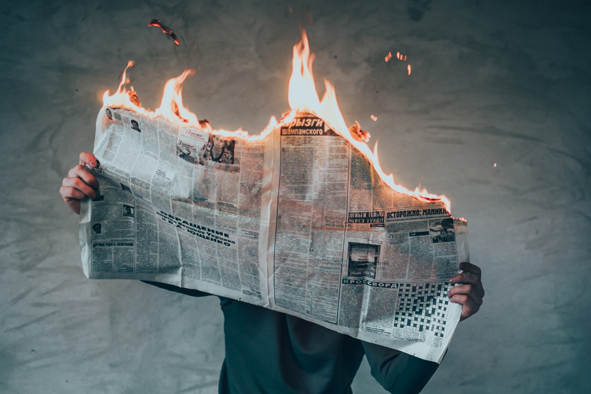
It’s 2019 and the classical consumption of traditional media has expeditiously become a thing of the past. The evolving landscape of technology has consequently established the birth of a social media phenomenon.
Research reveals that online media (notably social media platforms) have become the number one source for news consumption around the world.
How did we get here?
The rise in social networking behaviour over the last few years has resulted in end-users constantly refreshing/scanning their news feeds to obtain new information. With complete accessibility and social utility, online platforms such as Facebook, Twitter and YouTube, instantly deliver the latest news directly to consumers in a 24/7 cycle.
In light of this, mass media organisations quickly learned that in order to get in front of their consumers they needed to develop an online presence. Therefore. the vast majority of newspaper outlets have added digital subscriptions to their content and completely utilised social media to broaden their reach .
Put down your phone!
The endless capabilities that are present within today’s mobile phones has also been a significant factor towards the global shift in online news consumption. In fact, since 2013 studies have seen news consumption on mobile devices grow by 300 per cent.
In parallel with this incline, advertising, user subscriptions and relationships with news outlets are ultimately sinking. As a result, organisations are now relying on third-party platforms (i.e. Facebook and Twitter), in hopes of receiving more eyeballs and an increase in traffic.
A recent study found out of 800 Australians, 94 per cent of them use Facebook more than three times a day. This indicates the amount of advertising space that media organisations have to attract consumers.
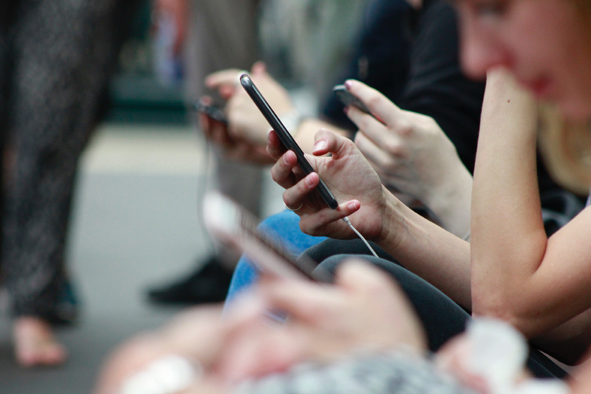
[Mobile Phone Use. Used with permission. Robin Worrall]
What does this mean?
Social media has become the new gatekeeper, and for the most part, consumer behaviour demonstrates that Facebook operates as a homepage for end-users.
Furthermore, a study conducted last year by the Pew Research Center found that two-thirds of American adults retrieve their news from social networks.
However, with the rise in digital media and social networking platforms alike, studies indicate there has been a steady decline in the overall engagement from the average reader. These consumers are likely to spend a staggering 15 seconds or less skimming through relevant news stories, and just 10 seconds on audiovisual content.
Are you sure that’s real?
Another issue surrounding the rise of online media consumption is the prevalence of ‘fake news’ stories. It would seem as though we are now in a time where news is no longer a commodity as it can easily be created, distributed, and obtained by the faceless internet community.
Moreover, due to the rise of popular platforms like BuzzFeed and Reddit, a stronger emphasis has been placed on virality. Content posted on online media now requires a call to action in order to boost the total amount of engagement/reach.
Consequently, this is where we observe the origin of ‘clickbait’ and the latter, such as ‘dank memes’. Further, the process of consuming news online has moderately become clogged with scandalous and untrue information. For instance, 57 per cent of US users believed that news stories found on Facebook were ‘largely inaccurate‘.
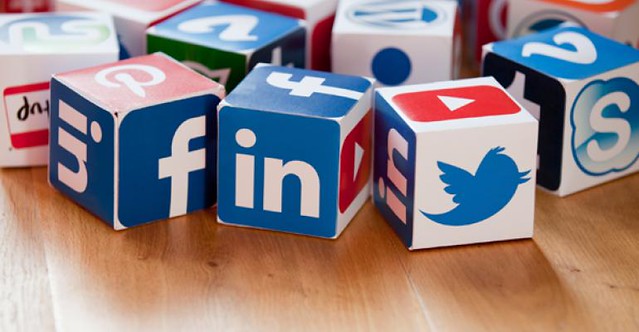 [Social blocks. Used with permission. Lorraine Harrison]
What does this mean for the future of online media?
Looking forward, digital marketing (through the use online media) is certain to evolve fluidly, as audiovisual content remains a key driver in capturing the consumer eye. While written content is getting shorter and simpler to keep readers engagement before directing them to a call of action.
Therefore, the future of online media looks to further influence social communication and align consumers to adapt in accordance with marketers. Both media organisations and ‘microinfluencers‘ will be competing across the online landscape to acquire audiences like a game of tug-o-war.
Tell me in the comments section below what you think the future holds for online media:
Timothy Thorpe is a Master of Marketing Communications student at the University of Melbourne. @timothythorpe47
[Featured Image: End of traditional media. Used with permission. Elijah O’Donnell]

